

Want to rehydrate a dried sourdough starter? Whether you’ve purchased a dehydrated sourdough starter or have some of your own dried starter, it’s really easy to reactivate it and get it bubbly and ready to bake with in just a few days! No matter where your dried sourdough starter came from, the process to rehydrate it is really quite simple. You’ll be baking sourdough bread within a week!
What is a Dry Sourdough Starter?
Dry sourdough starter refers to a sourdough starter that has been dehydrated to make it better for long-term storage. Drying the starter removes the water but preserves the beneficial lactic acid bacteria and wild yeast colonies. It’s kind of like they are suspended in time!
Activating a dried sourdough starter can take much less time than starting a sourdough starter from scratch.
If you are dehydrating a sourdough starter yourself, it’s best to wait until your starter is at least a few months old. That way, when you activate it, it will be bubbly and ready to bake with in just a few days. If you’ve purchased your dehydrated starter from a reliable source, you can be sure it is already a healthy, established culture.
Generally, the amount of starter you receive in a package is quite small – around 20 to 50 grams of starter. You really only need a tiny amount to start the process of activation.
What You’ll Need
- Digital Scale – essential for weighing everything accurately.
- A clean glass jar (16oz Mason Jar is perfect). If you want to feed into a clean jar each feed, 2 jars are necessary.
- Paper Towel & Rubber Band OR plastic lid – you can use either of these to cover your jar while your sourdough starter is rehydrated. I prefer a plastic lid just sitting on the jar, but you can use ei
- Flour – all purpose flour is fine.
- Water – good quality water, use slightly warm water if your kitchen is cold.
- Spatula – A silicone jar spatula is great for stirring your starter.
How To Rehydrate a Dry Sourdough Starter
The following feeding schedule can be used for any dried sourdough starter, whether it’s been left as flakes or ground into a powder. It’s best to keep your sourdough starter at room temperature during this process.
This post contains affiliate links. Please see our disclosure policy.
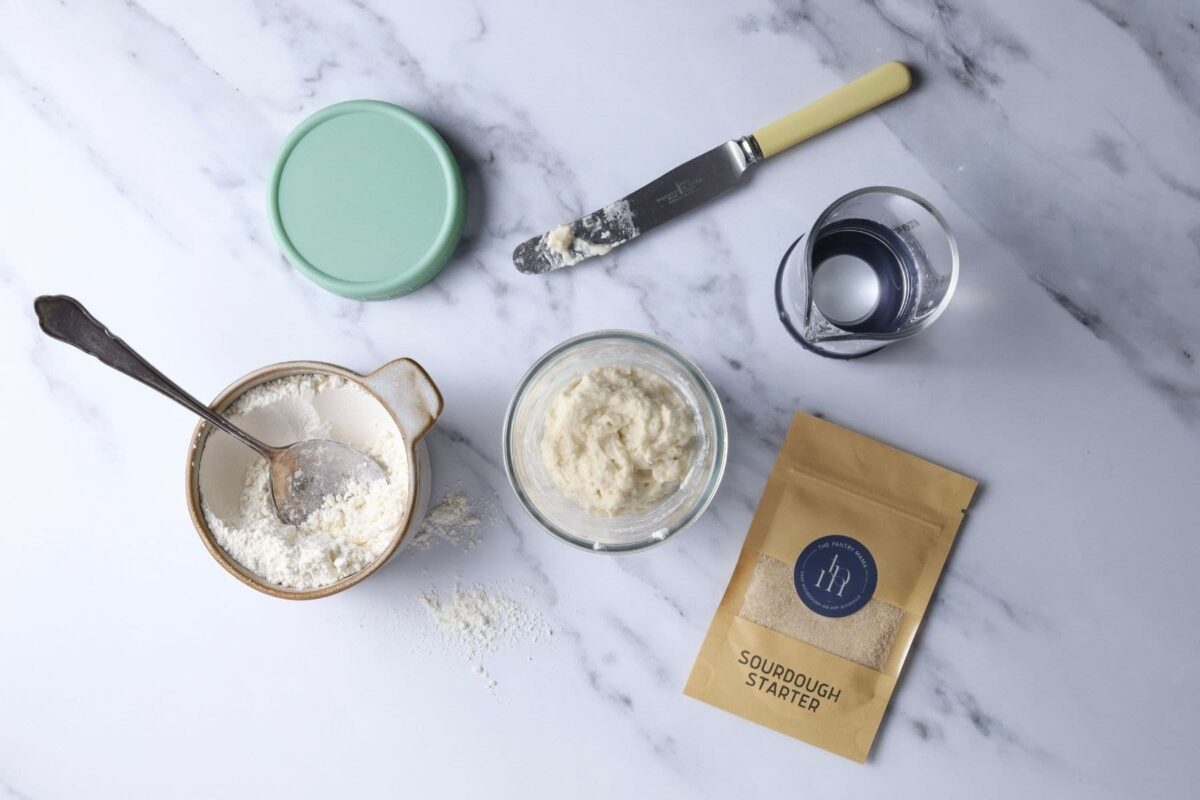
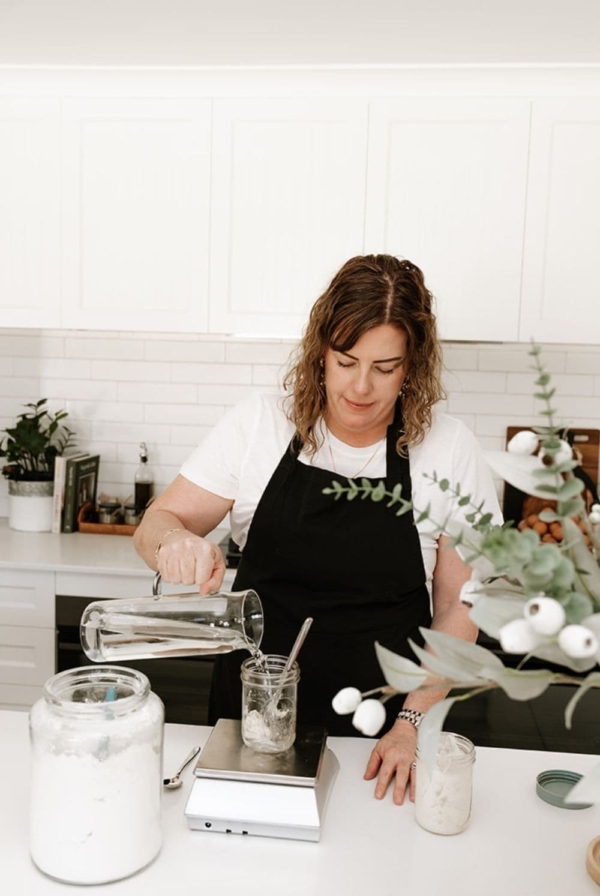
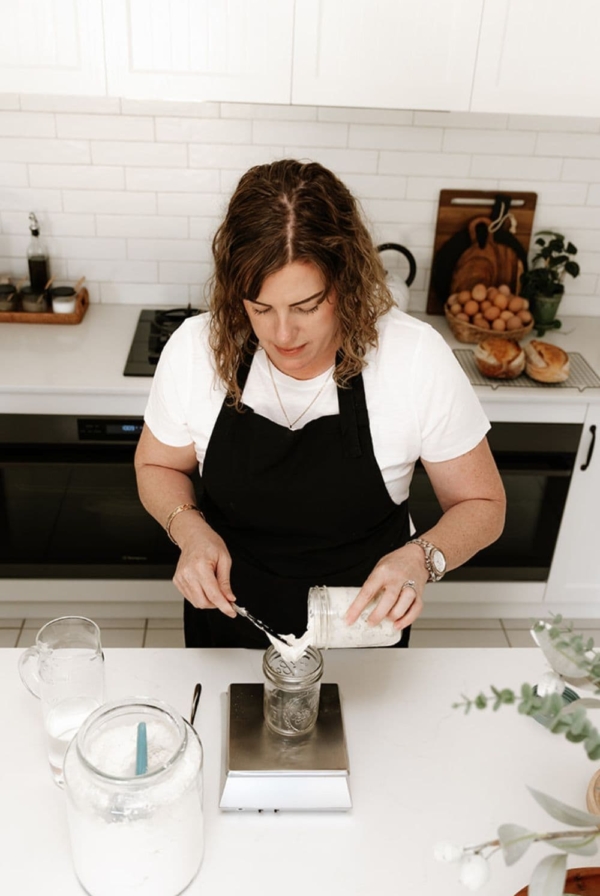
- DAY 1 – MORNING – Starting with a clean glass jar, add 10g of dried sourdough starter to the jar. Add 50g of warm water and stir it together until the starter is completely covered and coated by the water. Now add 50g of flour and stir in well. This is the first feeding and is designed to wake the dried starter up! Cover with a paper towel or loose lid and leave in a warm spot to ferment for approximately 24 hours.
- DAY 2 – MORNING – Discard all but 50g of your starter (you could just place 50g of the starter into a clean jar and get rid of the rest). Add 50g of water and 50g of flour to your mixture. Give it a really good stir to move things around. Cover with a paper towel or loose lid and leave for approximately 12 hours.
- DAY 2 – EVENING – After 12 hours, discard all but 50g of your starter (you could just place 50g of the starter into a clean jar and get rid of the rest). Add 50g of water and 50g of flour to your mixture. Give it a really good stir and cover, just like day 1 and 2.
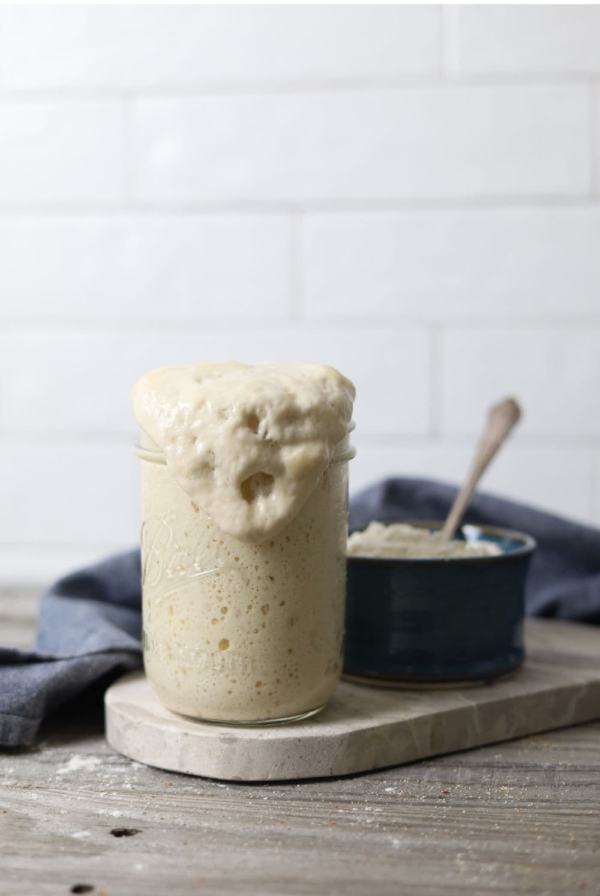
- DAY 3 – MORNING – Discard all but 50g of your starter (you could just place 50g of the starter into a clean jar and get rid of the rest). Add 50g of water and 50g of flour to your mixture. Give it a really good stir. You’ll need to repeat step 3 every 12 hours until your starter is bubbly and doubling consistently. If your starter was strong when it was dried, it may already be doing this. If not, just keep going. You want your starter to become bubbly and consistently doubling after each feed. You can read more about understanding when your sourdough starter is ready to bake with.
Once your sourdough starter is bubbly and doubling consistently, you’ll need to move it into ongoing maintenance mode. You can use this guide to learn how to feed a sourdough starter.
Best Tips for Rehydrating Sourdough Starter
While activating dried sourdough starter is a relatively easy process, there are a few things that will ensure you have success and produce a healthy starter.
- Flour – Make sure you use the same flour consistently through the process. If you wish to change the flour you’re using, try to wait until the starter has started doubling consistently. White flour like bread flour or all purpose flour is perfect. You could also use whole wheat flour if you prefer.
- Timing – Try to keep the timing of your feeding consistently 12 hours apart. Feeding the starter twice a day is important to get the starter going.
- Temperature – You should keep the starter warm (if possible) to speed up the activation process. Starters do best between 24ºC – 28ºC. Check out these tips for keeping your starter warm.
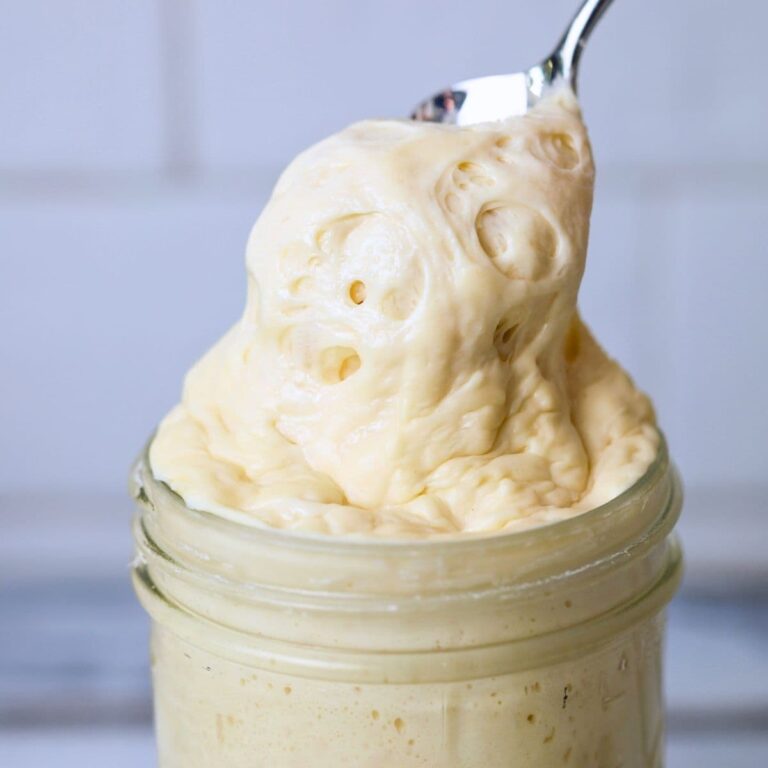
- Consistency – Depending on the flour you’re using, your starter may feel a little thicker or a little runnier. Ideally, you want it to be like warm peanut butter. In general, your sourdough starter will thin out a little as it ferments, so don’t stress too much if it feels a little thick. Try to keep to the same equal flour to water ratio. If you feel the starter is too runny, use these solutions to fix a runny sourdough starter.
- Storage – Once your starter is doubling consistently you can choose to store your sourdough starter in the fridge or feed it daily and store it on the counter.
How To Activate A Dried Sourdough Starter
Equipment
- Clean Jar
- Digital Scale
- Jar Spatula
Ingredients
- 10 g Dried Sourdough Starter
- 300 g Flour of your choice , (enough for around 6 feeds of 50g)
- 300 g Warm Water , (enough for around 6 feeds of 50g)
Instructions
- DAY 1 – MORNINGStarting with a clean jar, add 10g of dried sourdough starter. Add 50g of warm water and stir it together until the starter is completely covered and coated by the water. Now add 50g of flour and stir in well.Cover and leave for approximately 24 hours.
- DAY 2 – MORNINGDiscard all but 50g of your starter (you could just place 50g of the starter into a clean jar and get rid of the rest). Add 50g of water and 50g of flour to your mixture. Give it a really good stir.Cover and leave for approximately 12 hours.
- DAY 2 – EVENINGAfter 12 hours, discard all but 50g of your starter (you could just place 50g of the starter into a clean jar and get rid of the rest). Add 50g of water and 50g of flour to your mixture. Give it a really good stir.Cover and leave for approximately 12 hours.
- DAY 3 – MORNINGDiscard all but 50g of your starter (you could just place 50g of the starter into a clean jar and get rid of the rest). Add 50g of water and 50g of flour to your mixture.Give it a really good stir.You'll need to repeat step 3 above every 12 hours for around 3-7 days. You want your starter to become bubbly and consistently doubling after each feed.
Notes
Like this? Rate and comment below!









When making starter and you remove half of it, do you just discard this or is it mixed in again? Seems wasteful to throw out half a starter for a few days.
It’s discarded. It’s actually not that wasteful – you can read why here:
https://pantrymama.com/why-you-must-discard-some-of-your-sourdough-starter/
Hi what is step 3 that has to be repeated every 12 hours for 3 to 7 days?
At what point can I expect to see some activity from the rehydrated starter?
It can depend on how mature the sourdough starter was when it was dehydrated, as well as the temperature you’re keeping it at as you rehydrate it. I generally see my starter bubble after just a few hours when rehydrating it, but it’s normal for it take a few feeds before it’s thriving again. TPM x
Do you still keep it covered starting day 3 and moving forward?
When starting from scratch, you’re supposed to wait like a week to use the discard so the bacteria figure themselves out, right? But can you use it sooner when rehydrating starter? Thank you!
I don’t understand this. What is the difference between reactivating and starting a new culture. Both take the same amount of time. i followed other directions to dehygrate. I had no luck restarting and just started new. I had a 8 year old starter. Lost interest and restarted recently.
Can you use the discarded starter in a discard recipe? (such as the overnight sourdough bread) or must you actually throw it away? My Starter is approx 78 yrs old.
When this starter is fully ready to go is it still considered mature? Or does the drying process return it to a ‘new starter’ status?
Hi,
When I re hydrated back my starter, and it become double and peaks at around 8 hours.( 2nd day) Do I still need to continue to feed it for one week with the 12 hours interval feeding ? How could I shorten the peak time to within 4 hours?
Or when could I know when is my starter ready?
If it takes several days to reactivate dried starter, why not just start from scratch again?
It takes a few days to reactivate versus 3 to 4 months to create a viable starter from scratch 🙂
I don’t know what I’m doing wrong. I am on my second attempt of reactivating my dried starter. By day 3, it was doubling and bubbling beautifully for both AM and PM. Day 4 and today, day 5 it is flat with Zero rise:( This happened last time I tried this. I ended up tossing it out of frustration. This is the only starter I have left. I really want it to work. Any more advice? I’m using KA bread flour and my home is about 68-70° F in my home.
If I’m rehydrating an active healthy sourdough starter, can I simply collect the discard and use it in a discard recipe? Or does the discarded portion need to be disposed of, as when working with a brand new batch of sourdough starter?
I dehydrated my 6 month old starter. Waited a week to rehydrate. I’m on day 2 and can already see it growing and doing its thing. I plan to make my weekly bread using this starter. This is such a terrific way to store and to gift.
I have a thriving sourdough starter. Can I add some dehydrated sourdough to it? I would love to combine it with some 100 year old San Francisco starter.
I added a touch of honey and it really worked well. Thank you so much. I am on day 3 and it doubles now almost triples. Can’t wait to start making bread again. Love all your recipes. 😊
Excited to get mine started
Hi. This is a first for me. You mention “take 20g of dehydrated starter”. When I dehydrated my starter, I had measured out 50g. Then dehydrated. So, I weigh the dry starter to 20g? Thank you in advance.
Yes, you would just measure out 20g of dehydrated starter. You could then store the leftover as a back up, just in case 🙂
I am on week 3 of feeding my dehydrated starter. Few bubbles, good aroma, no rise. I followed your recipe to the “T”. Do I continue on or do I pitch it and make a new starter?
If it’s an established starter that’s been dried and you’re trying to reactivate, it should only take a few feeds. When I reactivate my dried starter it literally bubbles from the first feed. If you’ve been feeding for 3 weeks then you’re basically making a new starter anyway! If there are bubbles, then fermentation is happening. Are you keeping it warm? What sort of water are you using?