
Simple Sourdough Focaccia Bread [bubbly + delicious]
This post may contain affiliate links.

You need a good sourdough focaccia bread recipe in your collection. This sourdough focaccia recipe is super simple - it really just requires patience - but that's not new for sourdough, right?
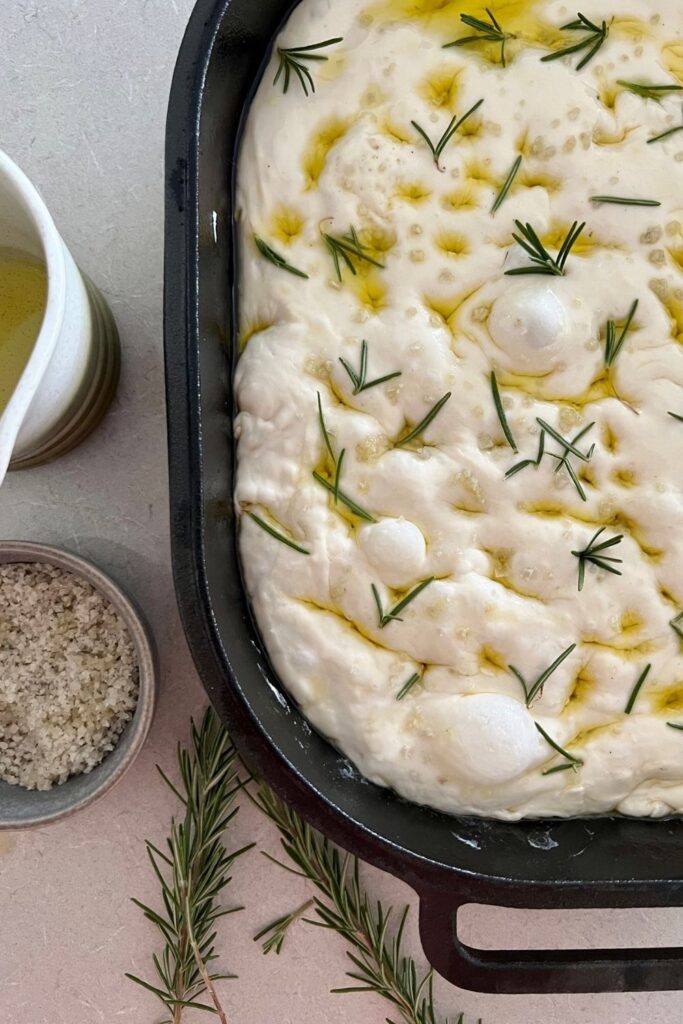
You can top sourdough focaccia bread with anything you like! I love the classic flavors of sea salt and fresh rosemary, but I've put some other suggestions further down for you to try. You're really only limited by your imagination! And if you love trying different toppings, check out these sourdough focaccia bread muffins.
I know you don't want to know my life story ... but focaccia bread is something that I have been making from scratch since I lived in Italy as a teenager. Back then I made it with yeast, but now I love that I can make it even more special by using my sourdough starter. It really does add a depth of flavor that you just can't get from commercial yeast.
Why You'll Love This Recipe!
Simple Ingredients - Flour, water, salt, olive oil and whatever herbs you have on hand are all you need to create this delicious bread.
No Fancy Equipment - you don't need a stand mixer for this recipe, a bowl and spatula is just perfect. It's a wonderful beginners recipe!
Endless Flavors - there's no limit to the flavor combinations you can create with this simple sourdough focaccia recipe! From sweet to savory, you're only limited by your imagination.
What is Sourdough Focaccia Bread?
Focaccia is an Italian bread, generally baked with good quality olive oil, fresh rosemary and salt. It is said to be similar to sourdough fougasse. Its magic lies in its simplicity.
Traditionally it's made with yeast (and more yeast than regular bread). Baking it with lashings of olive oil mean that it has a crusty, golden bottom and top with a light, yet chewy crumb inside. It's quite springy and spongey.
Similar to pizza dough in many ways, focaccia is sometimes referred to as "pizza bianca" or white pizza because it doesn't have the toppings that a pizza does.
Sourdough bread made with ripe sourdough starter has a deep sourdough flavor. It's fermented for a long time to develop the signature bubbles. Using a strong sourdough starter will give you the best chance at developing gorgeous bubbles as the dough ferments.
The time your focaccia bread takes will depend on the strength of your sourdough starter.
Ingredients
- Sourdough starter - This simple sourdough bread recipe requires a strong sourdough starter that's active and bubbly.
- Water
- Bread Flour
- Salt - I use regular fine salt for making the dough and then add flaky sea salt to the top of the dough before baking in the oven.
- Extra Virgin Olive Oil
- Rosemary Leaves - you can use fresh or dried rosemary, or really any dried or fresh herbs you like. Italian seasoning is really lovely with this if you don't have fresh rosemary on hand. If your rosemary bush is laden with leaves, you might also like to try this sourdough olive bread or this sourdough parmesan and rosemary wreath.
How To Make Sourdough Focaccia Bread
This beautifully simple recipe has very few hands on steps. It starts out as a wet, soupy mess, but through the power of fermentation, turns into a light, bubbly bread that will easily become your favorite!
You'll need a healthy, active sourdough starter that has been fed and is at its peak. This will give you the best chance of getting those beautiful bubbles (seriously whatever you do, don't pop these).
- Here's how to make bubbly sourdough focaccia bread:
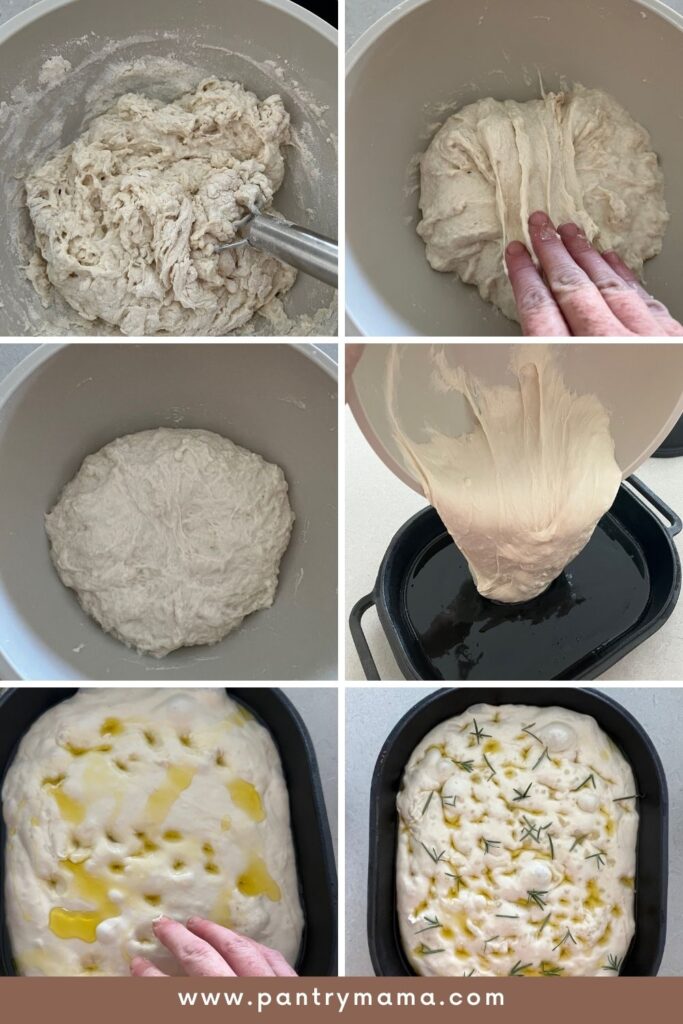
- Weigh out your active starter and water into a large mixing bowl. Mix the water and starter together briefly.
- Then add flour and salt and mix whole lot together until it forms a sticky dough. You don't want any dry flour left at all. You can use a jar spatula for this, it makes it much easier! Cover your bowl with cling film and let it sit for around 1 hour.
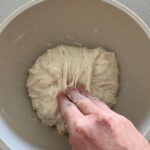
- After the dough has been through autolyse you need to bring it together into a ball. Work your way around the bowl, grabbing the dough from the outside, stretching it up and over itself, into the centre. You should feel the dough strengthen as you do this. It doesn't have to be perfectly smooth or tight, just work around the bowl stretching and folding (around 10 - 15 times is perfect).
- Now you want to leave your dough to bulk ferment at room temperature. Cover it with plastic wrap and leave it alone to double.
- Once the dough has doubled you need to shape the dough. Shaping sourdough focaccia is super simple (and absolutely forgiving).
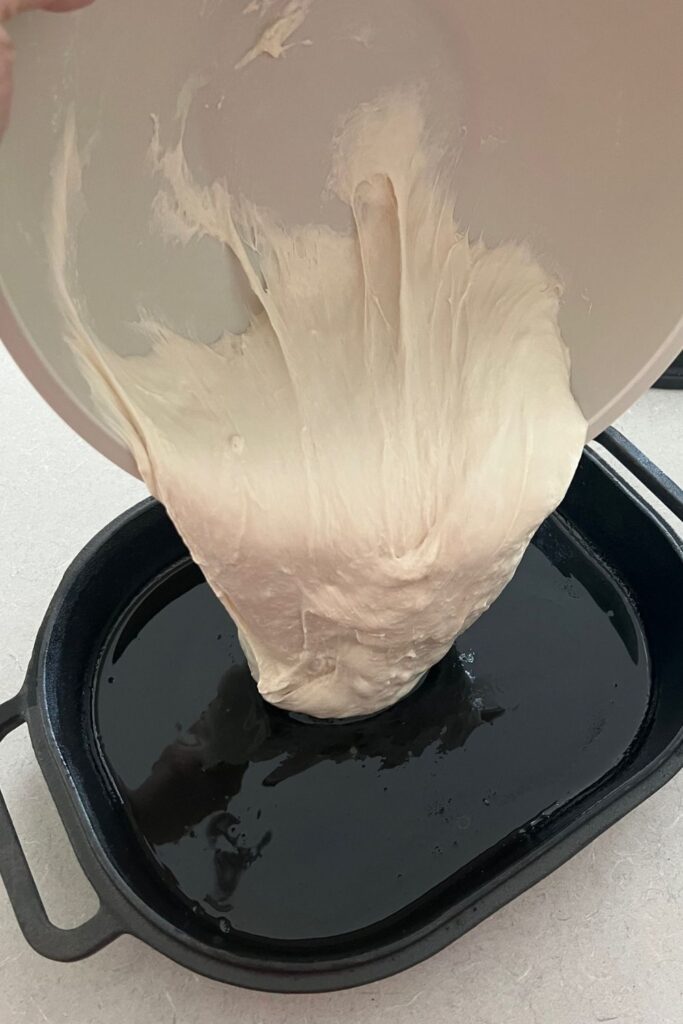
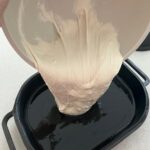
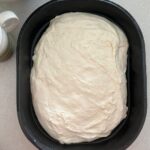
- Oil the bottom of the pan you're going to use (or line it with some parchment paper). Use a dough scraper to gently ease the dough into a lined baking tray or cast iron skillet. Rub your hands with a little olive oil and gently pull the dough out to fill the tray. Again it doesn't have to be perfect as it will naturally fill the tray as it proofs.
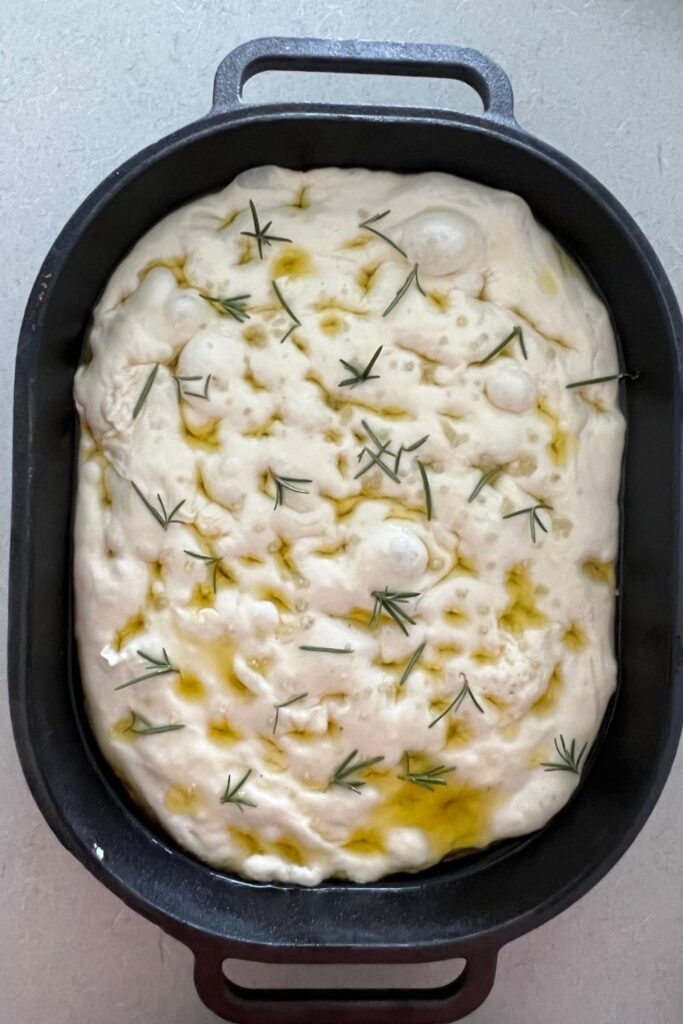
- Let your dough rise again (this is the proof or second rise). Leave it until it's spread out and filled the tray. It will be puffy and pillowy ... you might even have some gorgeous bubbles popping up.
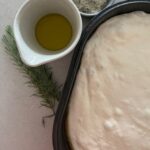
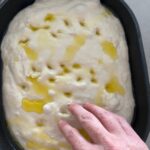
- Once the dough has filled the tray and is looking puffy and full of volume, you need to dimple the dough and add the toppings. Pour olive oil over the top of the dough and then push your finger tips into the dough to create dimples. You might see some bubbles pop up as you do this.
- Now sprinkle with sea salt and rosemary. Preheat the oven to 200C (390F).
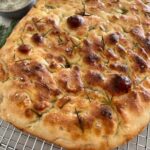
- Bake for 30 minutes at 200C (390F) or until golden brown.
Baker's Schedule
Many people have asked for ball park timing for this recipe, so I've added a sample baker's timeline here. These are just guidelines, as the actual timing will depend on the strength of your sourdough starter and the temperature of your kitchen.
| TIME | PROCESS |
|---|---|
| 9.00 PM | Night Before: Feed your sourdough starter 1:3:3 so it peaks in the morning (learn about sourdough starter ratios). |
| 6.00 AM | Next Day: Mix together sticky dough and let it sit for around an hour. |
| 7:00 AM | Bring dough together into a sticky ball (one set of stretch and folds). Cover the dough and leave at room temperature to bulk ferment. |
| 12.00 PM | Once the dough has doubled, use a dough scraper to tip it into the baking pan of your choice, ensuring you use olive oil and/or parchment paper. Cover and leave for second rise. |
| 5.00 PM | Dimple the dough and add the toppings of your choice. Allow the dough to sit while the oven preheats. |
| 5.45 PM | Bake sourdough focaccia bread for around 30 minutes or until golden brown. |
| 6.15 PM | Remove from the oven and allow to cool for around 10 minutes in the pan. |
| 6.25 PM | Transfer focaccia to a wire rack to continue cooling or eat warm for dinnner! |
If you want to cold ferment the sourdough focaccia bread in the fridge overnight, the best time to do this is once you've shaped the dough in your chosen baking pan. Allow it to rise a little and then place into the fridge. Take the dough out a few hours before you want to bake it to allow it to come to room temperature. You want the dough to be puffy and full of bubbles before it goes in the oven.
What Baking Pan To Use?
You can really bake sourdough focaccia bread in any pan that has a lip - even a baking tray is fine. I have baked this bread many, many times and my favorite way to do it is in a cast iron pan with lashings of olive oil. Olive oil is the secret to ensuring your dough does not stick to the pan!
I first started baking this bread in a baking pan lined with parchment paper. It comes out perfectly fine - I just prefer it in cast iron. I think that the bottom crisps up a bit more.
Here are a few ideas of what to bake your focaccia bread in:
- Cast iron skillet or bread pan (the skillet I'm using is 39cm x 26cm (15 x 10 inches).
- Divide into two portions and bake in round cake tins lined with parchment paper (I do this with 20cm (8 inch) cake tins.
- Baking tray (either using olive oil or baking paper) - any medium sized tray is fine, the dough can stretch out to fit.
Troubleshooting Sourdough Focaccia Bread
While this recipe is seriously simple, there are still a few issues that can arise. Sometimes it's the most simple of recipes that can give us the most grief!
I thought I'd put together a few troubleshooting tips that you can use as a reference in case you run into issues while making this bread.
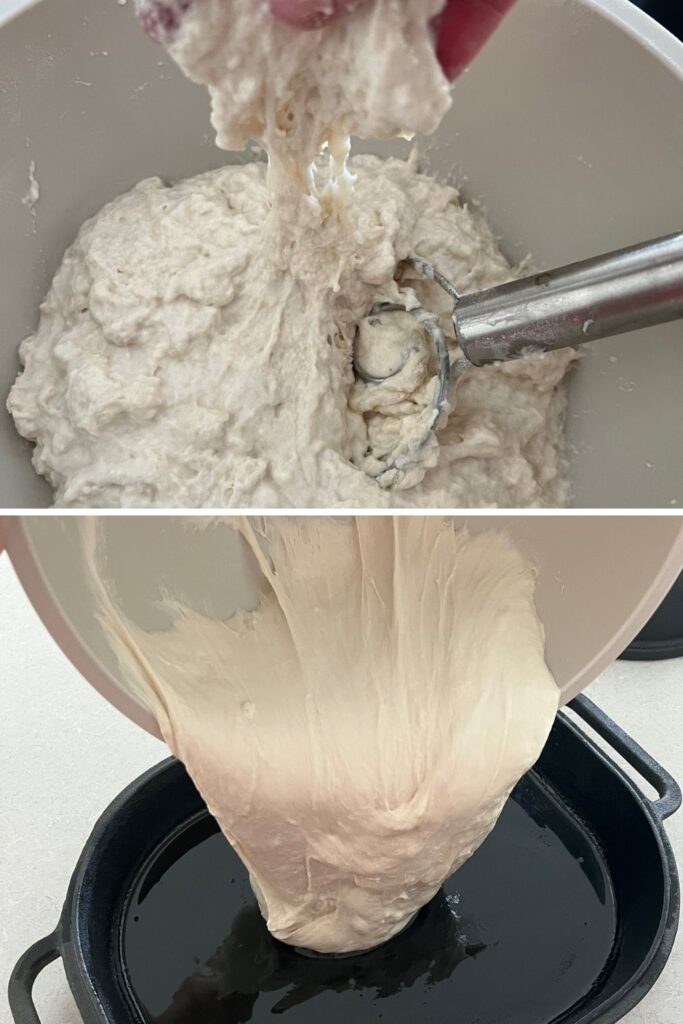
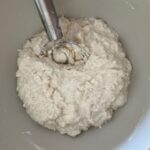
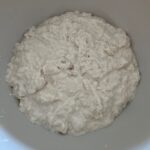
- Dough too wet & sticky - this is a high hydration dough. It will start off really sloppy but the dough should gain strength as you perform the stretch and folds. It should then gain strength and volume during bulk fermentation. Don't stress too much as this is a "free form" type of bread - you don't need it to hold its shape as it is baked in a pan. You can see in the photo above what my dough looks like after autolyse (before I start stretching and folding) - it's a wet mess! But looks how smooth and strong it is after bulk fermentation! Have patience.
- Type of flour - I recommend using bread flour for this recipe. If you need to use all purpose flour, reduce the amount of water by up to 50g because all purpose flour will not cope with higher hydration.
- Not bubbling - ideally you should get some nice big bubbles that form once the dough has been sitting in the pan for proofing. It does need to be placed in a warmer temp (ideally 24C - 28C).
- Dough sticky when dimpling - if the dough sticks to your fingers when you are dimpling it - you need more olive oil!! Seriously, there's no such thing as too much oil! It will give you a crispy outter and so much flavor!
- Focaccia Not Browning in the Oven - this is most likely due to under fermentation. If the dough hasn't had enough time to rest and ferment, it won't brown in the oven, resulting in a pale, unappealing focaccia. Make sure you give your dough plenty of time at room temperature - you want some serious bubbles to form!
How To Eat Sourdough Focaccia Bread
This sourdough focaccia bread recipe can be served and eaten in so many different ways.
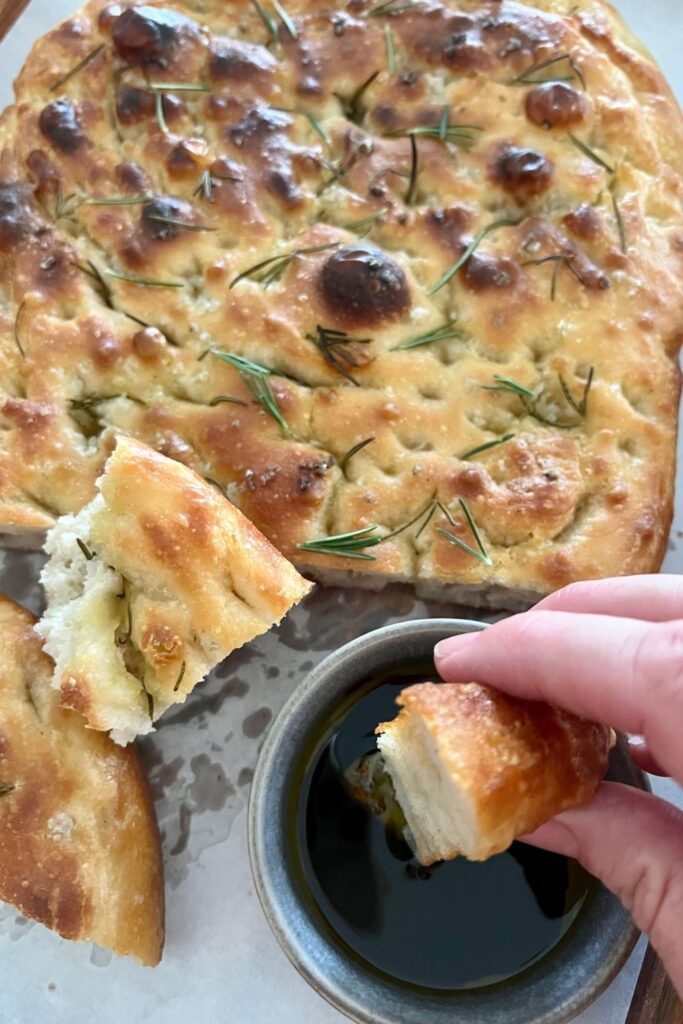
Dressed simply with olive oil, rosemary and salt it can accompany just about anything. Tear it, slice it, toast it, dip it - it lends itself to any occasion. And did I mention this bread dipping oil? It will take your sourdough focaccia to the next level!
It really can be a meal in itself (seriously ... just add wine lol). Oh and some of this whipped herb butter or this cultured butter!
Some of my favorite toppings for sourdough focaccia include:
- Make it like a pizza - add fresh tomato, red onion, olives, mini pepperoni or roll up some salami, shredded ham or bacon, lashings of mozzarella and a generous sprinkling of pizza herbs - YUM! Check out this sourdough pizza focaccia bread!
- Olives, cherry tomatoes and olive oil, with a sprinkling of dried oregano. Add some shaved parmesan cheese once it's out of the oven. Chef's kiss!
- Thinly sliced onion, fresh minced garlic, olive oil and lots of salt.
- Stud the focaccia with red or green grapes cut in half, drizzle with olive oil.
- Drizzle with melted butter, dust it with cinnamon sugar and dip into melted chocolate (seriously it's sooooo addictive!) or try this sourdough cinnamon roll focaccia bread!
- Maybe this Dill Pickle Cheddar Sourdough Focaccia is more your style?
How to Store + Freeze
This sourdough focaccia recipe is best eaten fresh and warm, right out of the oven. That being said, the olive oil will give this bread a longer shelf life. Stored in an airtight container or plastic bag, this will last a few days on the kitchen counter. It makes the loveliest grilled cheese sandwich when it's starting to stale.
This recipe freezes really well. You can cut the sourdough focaccia into squares and freeze in ziplock bags for convenience.
Frequently Asked Questions
This is a question I've been asked a lot, and truth be told I don't usually put a time limit because it will really depend on your sourdough starter and temperature of your kitchen. But when I make this with 100g of sourdough starter, I will bulk ferment it for around 4 to 5 hours and then place it in the pan and allow it to proof until it's really bubbly - this can take another 4 to 5 hours, depending on how warm it is
Many people say to use your over fermented sourdough to make focaccia. You can do this - yes. Will it taste as good as an intentionally made focaccia bread? No. Using over fermented dough to make focaccia will result in a very sour, dense loaf - as opposed to an actual focaccia bread which is bubbly and light in texture and flavor.
It's best to dimple focaccia before you bake it. If you don't, you risk it puffing up too much in the oven and you will lose that bubbly, spongey texture.
You could, but it will take a long time to ferment and it will make the bread very sour. It's best to stick with 100g of sourdough starter - unless you're making it in a very hot environment.
Yes you can - I have chosen not to. If you do add olive oil into the dough, you will need to reduce the hydration as this will make it very wet and soupy. Honestly, drizzling it with olive oil is enough to get the full flavor through the bread.
Yes you can use sourdough discard. But if using discard, you'd need to a pinch of yeast.

Sourdough Focaccia Bread Recipe
Video
Equipment
- Mixing Bowl
- Digital Scale
- Baking Tray
Ingredients
For the dough
- 100 g Sourdough starter (active and bubbly)
- 400 g Water (can increase or decrease by 30g if desired)
- 500 g Bread Flour
- 10 g Salt (fine salt)
For the topping
- 30 g Olive Oil (extra virgin)
- 10 g Sea Salt (flaky sea salt)
- 1 tablespoon Rosemary Leaves (fresh or dried)
Instructions
- Mixing The DoughWeigh out your sourdough starter and water into a large bowl.Mix the water and starter together briefly. Then add flour and salt and mix whole lot together until it forms a sticky dough. You don't want any dry flour left at all.You can use a dough scraper or jar spatula for this).

- Cover your bowl with cling film or a damp tea towel and let it sit for around 1 hour. It's ok if it's a little bit longer, it's not going to matter too much.
- Strengthening the DoughAfter the dough has been through autolyse you need to bring it together into a ball. Work your way around the bowl, grabbing the dough from the outside, stretching it up and over itself, into the centre. You should feel the dough strengthen as you do this. It doesn't have to be perfectly smooth or tight, just work around the bowl stretching and folding (around 10 - 15 times is perfect).
- Bulk Ferment:Now you want to leave your dough to bulk ferment at room temperature. Cover it with a tea towel or plastic wrap and leave it alone to double (see notes).Focaccia is super forgiving so it doesn't need to be perfectly doubled - near enough is fine.
- Shaping Focaccia:Once the dough has doubled you need to shape the dough. Shaping focaccia is super simple (and absolutely forgiving). See my notes in the post above for details on baking pans/dishes.Use a dough scraper to gently ease the dough out into your desired pan.
- Rub your hands with a little olive oil and gently pull the dough out to fill the tray. Again it doesn't have to be perfect as it will naturally fill the tray as it proofs.
- Second Rise:Let your dough rise again. Leave it until it's spread out and filled the tray. It will be puffy and pillowy ... you might even have some gorgeous bubbles popping up.
- Topping:Once the dough has filled the tray and is looking puffy and full of volume, you need to dimple the dough and add the toppings.Pour olive oil over the top of the dough and then push your finger tips into the dough to create dimples. You might see some bubbles as you do this.Now sprinkle with sea salt and rosemary.
- Baking Sourdough Focaccia:Preheat the oven to 200C (392F).Bake for 30 minutes or until golden brown.
Notes
- Cast iron skillet or bread pan (the skillet I'm using is 39cm x 26cm (15 x 10 inches).
- Divide into two portions and bake in round cake tins lined with parchment paper (I do this with 20cm (8 inch) cake tins.
- Baking tray (either using olive oil or baking paper) - any medium sized tray is fine, the dough can stretch out to fit.
Nutrition



Is it OK to let this bulk ferment overnight before shaping into the pan for second rising and baking? Would counter or fridge be best?
How long does it take to double. Says to see notes but there was nothing that referred to doubling time
Thank you,
Gaia
About how long will the second ferment take?
Pointers if adding caramelized onions and maybe Brie on top?
How long is the bulk ferment generally. You only said until it doubles but does it take 1 hour, 3, 5, 7, overnight?
After the bulk rise and its placed into the pan it will be baked in, can I let it rise for a few hours and then place in the fridge overnight? Will this cause the sour taste to increase?? (I've got a picky I don't want that taste child, who happens to also love all things sour dough, as long as she doesn't know)
This recipe is good as is but I will say I am on my fourth or fifth round and for the second time I’m using 200 g of day old discard rather than 100 g of active starter and it works really well! The first time was out of desperation but it did not disappoint!! I can see it working a tad faster and the first loaf I tried like that turned out really fluffy and airy. My starter was given to me and is extremely active (I can’t take credit, it can not die) so I think I could honestly probably make a standard boule with it at a day unfed but haven’t tried yet because how disappointing would that be if it didn’t turn out… One day when I don’t have so many hungry mouths to feed lol!
If I bake this in a 10”25 cast iron skillet, should I use less ingredients? I’m worried my skillet is too small for these measurements 🙁
Hi Sarah, A 10" round cast iron may be a bit too small for these measurements, but you can use any sized baking tray, or even cake pans. Kate has made this recipe in two 8" cake pans. 🙂
Delish!! My first focaccia and it’s sooooooo good!
I made another today with cheddar and jalepenos. So yummy!
I made this tonight on my 3rd week of my sourdough journey. It was amazing. Chewy and crispy, my daughter said it was a meal. I will put this in my rotation.
I am baking mine in a Pyrex on with parchment paper and olive oil on it. Oven at 400 F. It was not brown at all after 30 minutes, and still does not look done after another 10. Trying another 10. I was a little heavy handed with the olive oil and my oven temp may be a little off. I didn't see any other comments about baking time. We will see. I am sure it will taste great anyway!
Can this be covered and put in the fridge overnight after the first rise and shape in to the baking dish?
Then take out of the fridge in the morning for second rise, top and bake for lunch?
Yes, you can put the focaccia dough in the fridge overnight. I would place it in the fridge after you've allowed it proof a little in the pan, then when you're ready, take it out and allow it to fully fill the pan at room temperature and then bake.
How thick is this foccacia after baked? Is it thick enough to slice in half for making sandwiches if I made in like a 9x13 pan?
This came out amazing. I have been playing around with sourdough breads for a few years now. This was the easiest and (you are right!) most forgiving sourdough. My husband, who went to cooking school, had a fit over it and said it tasted like the focaccia he had in Italy. I made sandwiches out of it today. So yummy! I will definitely be making this again! Thank you!!!
About how long does the bulk ferment take? And how long for the 2nd rise? Just trying to plan my day lol. Thank you for the recipe! Can’t wait to make it!
Pantry Mama, you have guided me so successfully through my first year as a sourdough newbie! I doubled all of the ingredients of recipe except the sourdough starter (tripled that, with super bubbly and happy starter, so 300gr) AND added one Tbs each of honey and instant yeast. Autolyzed 30 mins, did a big stretch and fold, plopped into lavishly olive oiled-up baking pans, covered with plastic cling and let sit in the oven (turned off but with oven light on) for about two hours. Tucked them into the preheated oven well-dimpled, oiled, and showered with fleur de sel and snipped fresh rosemary and sage. JUST LOOK AT IT... and I am astounded by how gorgeous and delicious it is... it has the "squeakiness" of a lean sourdough boule but more tender, with a softly chewy spring; delicately crunchy, deeply browned bottom crust; and the gentlest whisper of a tang that almost feels imagined rather than tasted (which is what I was going for here). BRILLIANT!!!!! Thank you!! I have beautiful pix and would love to show them here but can't figure out how lol
Can I bulk ferment overnight then refrigerate in the morning? Then after work would I take back out to warm up, shape, rise and bake?
I started this last night. Had great rise overnight. Put it in a 10x15 stone this morning but totally forgot to oil the stone so pulled it out an hour later and then oiled it and put back in stone. But it’s been a couple hours sitting at room temp and hasn’t risen or spread much. Do you think I messed it up or it just needs more time? Not sure what to do here. It is bubbling and has spread but not all that much yet.
First time making a focaccia and first time working with sourdough, and everything turned great! So I wanted to thank you for an easy to understand and easy to follow recipe! I think resting the focaccia in the pan you're baking it is soooo brilliant!
Is the second fermentation in the refrigerator or out?
It's still at room temperature 🙂
I added 2 cups of shredded sharp cheese and it was amazing. Mix with four before adding water
Can you do a cold retard overnight in the fridge after the bulk ferment so it has a lil more sour flavour?
Yes you can 🙂 I've added information for this to the post under "Baker's Schedule" xx
Could you provided some estimated times for the ferment and proofing stages? It would be nice to know, even though they may vary from person to person (starter to starter), for planning purposes. Thanks!!
I've added this information to the post under "Baker's Schedule". I hope this helps you navigate this recipe more easily 🙂 xx
Approximately how long does it take for the bulk ferment? I did not see this in your notes.
This is a higher hydration dough so it should ferment faster than a drier dough, but it's hard to say how long it will take. It can vary depending on kitchen temperature.
I am looking forward to trying this recipe! I have my dough currently undergoing its first proof and once it doubles, I plan to use a medium baking sheet. How long does the second rise/proof typically take once it’s in the pan? Thank you!
I've added information around this to the post under "Baker's Schedule" 🙂 I hope this helps xo
Wondering about how long each fermentation step takes? I know the bulk has to be done at room temperature, but can the next one be put in the fridge overnight?
My hubby love it
This recipe is fabulous! I will be making this on a regular basis.
Your recipes are the best. Life changing! Everything I make is easy and delish. I now only come to your site to find recipes. My only question and this is on most of the recipes I make (ie Hawaiian rolls, garlic rolls, this focaccia) my tops never brown. I have made them in Hawaii (sea level) in Colorado (at altitude 5680ft/1731m) in electric and in gas ovens hahahaha all different situations and my tops never brown! What am I doing wrong?? Is it placement in the oven? My sourdough bread, the star loaves(which I also make into braided twists) monkey bread, come out beautifully in all these different situations. Which by the way if you haven’t tried her star loaf You must for this Christmas season!!! Thank you in advance for the help and thank you for making all these recipes that are just so amazing!!
Hi Kim, are you brushing the tops with oil/butter? That typically helps the browning on top.
Hi. Can I add mashed potatoes to this focaccia recipe, and if so, would there be any adjustments to the flour and/or water I would need to make? Thank you.
I'm sorry I've never added mashed potatoes so I'm not sure. It would definitely require some adjustment as this is already a very wet dough 🙂
Hi I am excited to try and make this! Can you give any rough estimates for how many hours the first fermentation takes and how many hours the second rise takes (once you have transferred the dough into the iron skillet). I know it differs based on a lot of factors, but a rough estimate would help me plan ahead! Thanks!
We honestly can't tell you how long it takes - even in Kate's kitchen it takes different amounts of time each day depending on the temp of the kitchen, whether the doors are open or the oven is on etc. It is a higher hydration dough so it should ferment faster than a drier dough 🙂